
Marrakech has been a crossroads of trade, culture and civilisation since the 11th century. It sits at the foot of the High Atlas Mountains, 460 metres above sea level, in a landscape of red plain that gives the city the distinctive colour behind its name: the Red City. Almost everything worth seeing is contained within or immediately adjacent to the medina — the ancient walled quarter that UNESCO listed as a World Heritage Site in 1985 and that has been continuously inhabited for over a thousand years.
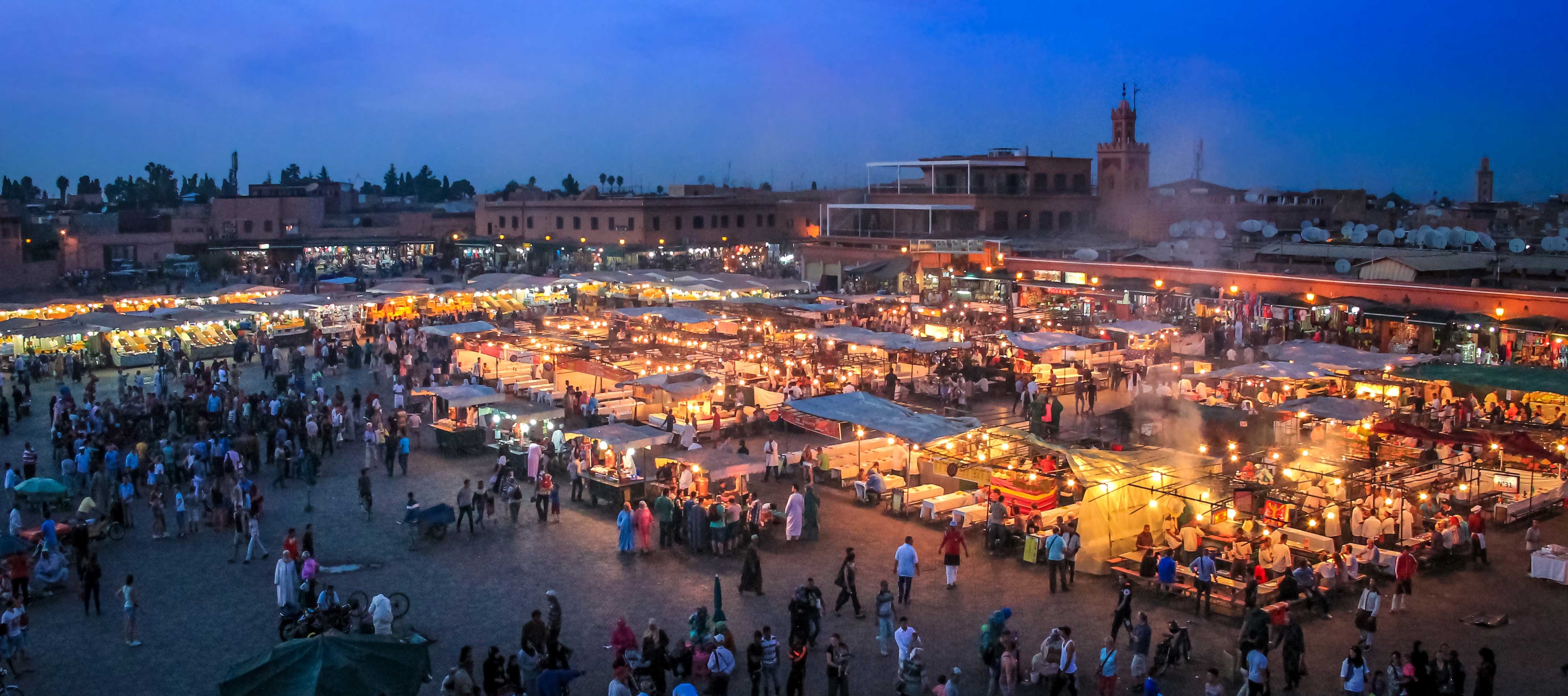
The centre of the medina is Jemaa el-Fnaa — one of the most extraordinary public squares Thomas has encountered anywhere in the world. During the day it is a market of orange juice vendors, henna artists and dried fruit stalls. As the sun drops, the square transforms entirely: food stalls appear, musicians take their positions, storytellers gather circles of listeners. The noise, the smell and the energy of Jemaa el-Fnaa at dusk is something Thomas finds impossible to prepare guests for. It simply has to be experienced.
From the square, the medina’s souks radiate north in every direction — covered market streets divided by trade, where spice sellers, leather workers, metalwork craftsmen and textile dealers each occupy their own quarter. Getting lost in them is not entirely avoidable, and Thomas considers that part of the point. The Bahia Palace, a 19th-century courtyard complex of extraordinary Moroccan craftsmanship, is a 15-minute walk away and among the finest examples of the country’s architecture open to visitors. The Saadian Tombs — sealed behind a wall for 200 years and only rediscovered in 1917 — are smaller in scale but remarkable in their detail. The Jardin Majorelle, the vivid blue garden created by French painter Jacques Majorelle and later restored by Yves Saint Laurent, is the most photographed garden in Africa and, in the early morning, one of the quietest places in the city.
Staying in a riad is the defining Marrakech experience for couples and independent travellers. From the street, a riad reveals nothing — a plain wooden door in a narrow alley, no signage, no indication of what lies beyond. Open that door and you find a private world: a tiled courtyard, a fountain, rooms arranged on two or three floors around the central space, a rooftop terrace with views across the medina roofline to the Atlas Mountains beyond. Breakfast on that terrace on a clear morning is the kind of experience guests come back describing when they try to explain why Marrakech stayed with them. GotoBeach offers a selection of hand-picked luxury Marrakech riad stays alongside more accessible options for guests booking their first visit.
The food in Marrakech is, in Thomas’s experience, exceptional at every level. Slow-cooked tagines of lamb with preserved lemon, couscous served with seven vegetables, pastilla of pigeon and almonds in filo pastry dusted with cinnamon — traditional Moroccan cuisine is available from street stalls to formal restaurant dining, and the quality across that range is consistently high. The rooftop restaurants overlooking Jemaa el-Fnaa are Thomas’s recommendation for a first evening in the city: order a fresh orange juice, watch the square come alive below, and understand immediately why Marrakech has the reputation it does.
The best time to visit, in Thomas’s experience, is March to May and September to November. Spring brings temperatures of 22–26°C, clear skies and the Atlas Mountains still capped with snow — a combination that is difficult to match anywhere else at that time of year. Autumn delivers similar conditions with lower hotel prices after the summer peak. July and August are genuinely hot in Marrakech — 38–42°C is not unusual — and while the city functions perfectly at that temperature, guests sensitive to heat will find spring or autumn considerably more comfortable for exploring the medina on foot.
Beyond the city, the Atlas Mountains begin less than an hour from Marrakech by road. The Ourika Valley, the Ouzoud Waterfalls and the mountain village of Imlil — base for treks towards Toubkal, North Africa’s highest peak — are all accessible as day trips from the city. For guests who want to combine Marrakech with a beach stay, Agadir is three hours south through the Atlas — a journey Thomas considers one of the most scenic drives in North Africa. GotoBeach can book this as a single ATOL-protected Morocco package holiday.
For cheap Marrakech holidays, luxury Marrakech breaks or a twin-centre Morocco holiday combining Marrakech with Agadir — book through GotoBeach with full ATOL protection under licence #11211, low deposits and the honest advice of a team that knows the destination.