

Antalya Beyond the Resorts: The Quiet Coast
Drive south-west for an hour and the all-inclusive strip runs out. What replaces it is the reason people come back.
By Raşit Eti · Turkey Destination Specialist · Last updated: August 2026
Everything British travellers know about Antalya sits in a sixty-kilometre band east of the airport. Drive the other way instead — south-west, past Kemer, where the coast road starts climbing — and within an hour the resorts stop entirely. What follows is a national park, an ancient city in a riverbed, a mountain that has been on fire for thousands of years, and a series of bays where the largest building is a family pension. This is the Antalya I take visitors to when they ask what the coast was like before.
- Çıralı — around 90 km from Antalya. Protected turtle beach, no large hotels, and the best base on this coast.
- Olympos — an ancient city scattered through a river valley that opens onto the beach. About 80 km.
- Yanartaş — natural gas vents that have burned on the mountainside since antiquity. Go after dark.
- Adrasan and Suluada — a quiet bay, and the boat trip out to the clearest water on this coast.
- You can do all of it as day trips from a resort, but two nights out here is a better holiday.
Where the quiet coast actually starts
Orientation first, because the geography is what makes this work. Antalya city sits at the corner of a bay. Everything east of it — Lara, Kundu, Belek, Side, Alanya — is flat coastal plain, which is why the big resorts are there. Everything west and south of it, from Konyaaltı onwards, is mountain. The Taurus range comes down to the water, the coast road becomes a series of bends and climbs, and there is simply nowhere to build a nine-hundred-room hotel.
That geography has protected this stretch. Much of it falls inside the Olympos Beydağları national park, development is restricted, and the result is a coastline that looks the way the Turkish Mediterranean looked in the 1970s. It is roughly an hour and a half from Antalya airport to Çıralı, and about the same again to Kaş at the far end.
Kaleiçi — the right place to start
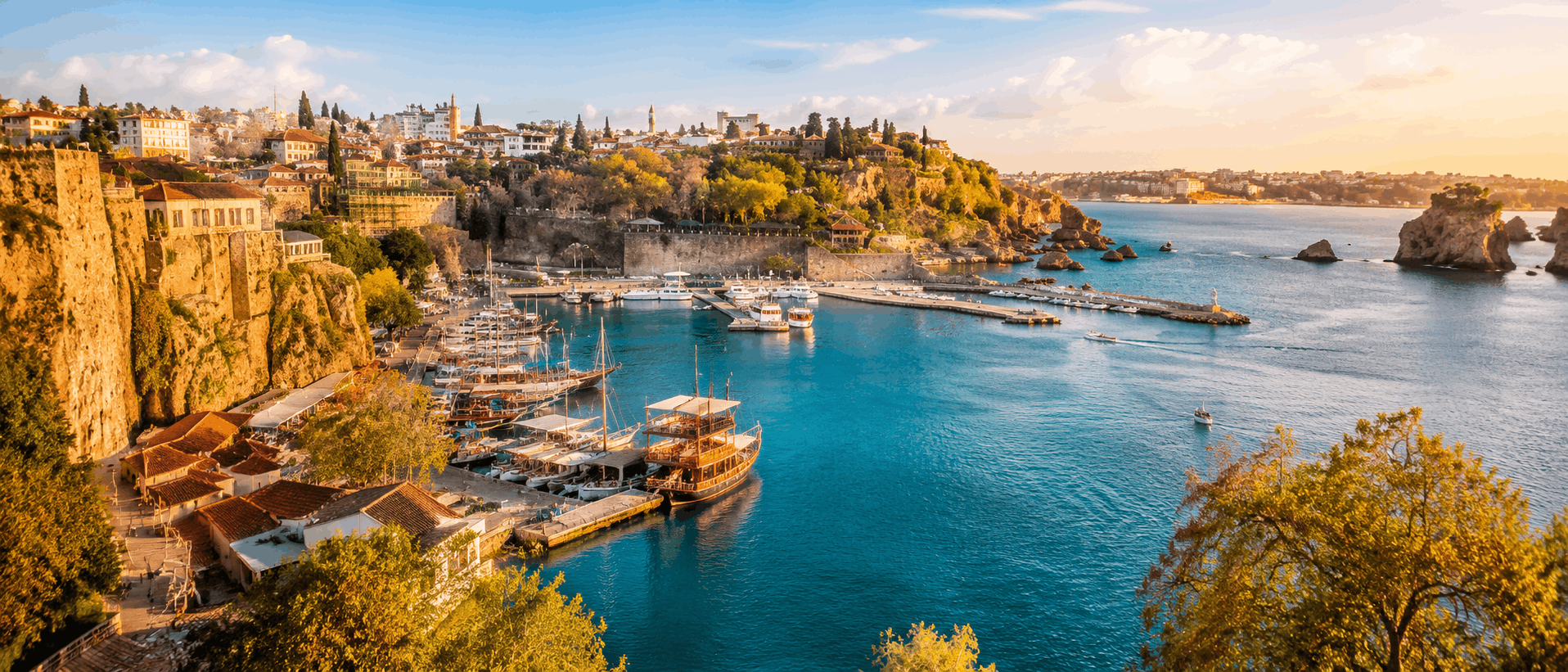
Before you head out, spend an evening in Antalya's old town. Kaleiçi is a walled Ottoman quarter wrapped around a Roman harbour: narrow lanes, courtyard houses converted into small hotels, rooftop restaurants and a marina where the gulets tie up. It is the one part of the city that feels nothing like a resort.
Practically, it is also the most sensible base for exploring west, and the Antalya city centre hotels put you at the head of the coast road rather than an hour east of it. A night here at the start of a trip changes the shape of the whole week.
Konyaaltı — the city beach worth an afternoon
Antalya's own beach runs west from the cliffs below the old town, backed by a long promenade and looking straight across the bay at the mountains. It is pebble rather than sand, which keeps the water noticeably clearer than the beaches east of the city, and it is a genuine city beach — locals, cafés, families after work.
It is not a hidden gem and I am not going to pretend it is. But it is the best short introduction to what this side of Antalya looks like, and the Konyaaltı beach hotels are a reasonable base if you want city access without staying inside the old walls.
Çıralı — the one to book if you only pick one
About ninety kilometres from Antalya city, reached by a winding descent off the coast road, and the most complete version of what this coast offers. Çıralı is a long pebble-and-sand beach at the mouth of a valley, backed by orange groves and small guesthouses. There are no large hotels, and there will not be: the beach is a protected loggerhead nesting site with genuine enforcement, and the building restrictions that come with that have preserved the place.
What you get is a beach with a handful of low-key restaurants along it, mountains at both ends, and evenings where the loudest thing is the sea. Turtles nest here through the summer, so the same rules apply as on the Belek coast: no lights on the sand at night, and keep away from marked nests.
Çıralı also happens to sit exactly between the two best things on this coast, which is why it makes such a good base.
Olympos — an ancient city in a riverbed
At the southern end of Çıralı beach, about eighty kilometres from Antalya, the ancient city of Olympos runs inland along a river valley. It is unlike any other classical site in Turkey because almost nothing has been cleared: sarcophagi sit under fig trees, a theatre is half-buried in scrub, and a temple gate stands in the middle of a wood with the river running past it.
You walk down the valley and come out on the beach, which is the correct way to do it. Allow a couple of hours and take something on your feet you can get wet — the path crosses the riverbed in places, and in spring there is water in it.
Olympos is the strongest argument I know against the idea that you need to leave the coast to see ancient Turkey. It is a ruin you swim from.
Yanartaş — the mountain that burns
Above Çıralı, a stone path climbs for twenty or thirty minutes to a rocky slope where natural gas seeps from vents in the ground and burns continuously. The flames have been alight for as long as anyone has recorded — they gave the ancient world the myth of the Chimaera, and sailors used them as a navigation mark.
Go after sunset. In daylight the flames are pale and slightly disappointing; in the dark the whole hillside flickers. Take a torch for the walk down and proper shoes, because the path is loose stone. It is the single most memorable hour on this coast, and it costs almost nothing.
Adrasan — the bay where the road ends
Half an hour south of Olympos, over a headland, Adrasan is a wide bay with a long beach, a river mouth at one end and pine-covered mountains all around. There is a road in and no road out, which tells you most of what you need to know about the atmosphere.
It is a working village that takes visitors rather than a resort that has a village attached. Fishing boats run day trips from the beach, the restaurants are family-owned, and the pace is slow in a way that people either love immediately or find dull by day two. If you are the first kind of traveller, Adrasan is the place on this coast you will want to come back to.
Suluada — the boat trip worth taking
From Adrasan, the local boats run out to Suluada, a small uninhabited island with white sand and water so clear that the Turkish tourist trade has taken to calling it the Maldives of Turkey. That is marketing, and it is also not far off — the sand is volcanic-bright and the shallows are genuinely extraordinary.
The trip usually takes in the Olympos canyon on the way. Boats go daily through the season and you book on the beach that morning rather than through an agency. Take a hat, take more water than you think, and go early if you want the island before the other boats arrive.
Kaş — the diving town at the far end
Two and a half hours or so south-west of Antalya, and worth the drive if you have the time. Kaş is a small town on a peninsula with a Lycian rock tomb at the top of the main street, a harbour full of dive boats and a laid-back, faintly bohemian atmosphere that is unlike anywhere else on this coast.
The diving is the draw — the water is clear, the drop-offs are close in, and there are wrecks and submerged ruins within an easy boat ride. Our small Kaş hotels are small properties rather than resorts, which is the whole point of the place. If you want the quiet coast with somewhere to eat and drink in the evening, Kaş is the answer rather than Adrasan.
Eating properly on this coast
The food away from the resorts is a different proposition, and it is one of the main reasons to come out here. What to look for:
- Grilled sea bass and bream — ordered by weight, priced by the kilo, cooked whole. The riverside and beachfront restaurants at Çıralı and Adrasan do this as well as anywhere in Turkey.
- Serpme kahvaltı — the sprawling Turkish breakfast, twenty small plates of cheese, olives, jam, eggs, honey and clotted cream. A mountain village version of this is a two-hour meal and worth planning a morning around.
- Antalya piyaz — the local white bean salad, made here with tahini, which is a genuine regional difference rather than a variation.
- Fresh pomegranate juice — pressed at roadside stalls, and in autumn it is a completely different drink from what you get in a hotel.
- Dondurma — the stretchy Turkish ice cream, best from the harbour stands in the old town.
The general rule out here is that small and family-run beats large and licensed. If you want a fuller treatment of eating in the city, I have written separately about where to eat fish in Antalya.
Phaselis and the Kemer bays — the halfway stop
If the full drive to Çıralı is more than you want, the coast between Kemer and Tekirova gives you a compressed version of the same thing an hour closer to Antalya. Phaselis is the reason to stop: a Lycian and Roman harbour city built across three small bays, with the ruined main street running from one beach to another and pine forest growing through the middle of it.
You can swim off the ancient harbour walls, which is not a sentence you get to write about many archaeological sites. The bays are small, the water is clear, and it is busy in August and almost empty in October. From any of the Kemer resort hotels it is a short drive rather than an expedition, which makes it the sensible compromise for anyone based on the eastern side who wants a taste of this coastline without a four-hour round trip.
What you give up out here
I would rather be straightforward about the trade, because this coast is not for everybody and a disappointed guest is worse than no guest.
There is no all-inclusive. The accommodation at Çıralı and Adrasan is pensions, small hotels and bungalows. You eat out, you pay for each meal, and the standard is generally excellent but it is not a resort. If the appeal of your holiday is that everything is paid for in advance, this is the wrong coast.
The beaches are pebble in places. Çıralı is a mixture, Olympos is coarser, and none of it is the fine sand of the Lara strip. The compensation is water clarity, which on this coast is in a different class.
Facilities are modest. Limited nightlife, no aquaparks, no kids' clubs, and in some of the smaller places power and water can be less reliable than you are used to. Families with young children generally find a week out here harder work than a week in a resort.
The driving is real. Bends, gradients, and slow lorries. It is not difficult driving but it is tiring, and doing it at the end of a long flight on arrival day is a mistake.
What you get in exchange is a coastline that has not been rebuilt for tourism, ancient sites you have largely to yourself, and evenings that are genuinely quiet. For the right traveller that is not a compromise at all — it is the entire point.
How to plan it
| Place | From Antalya | Time needed | Best for |
|---|---|---|---|
| Kaleiçi | City centre | An evening | Old town, dinner, marina |
| Konyaaltı | City centre | An afternoon | Clear water, city beach |
| Çıralı | ~90 km | Full day, better as two nights | Quiet beach, turtles |
| Olympos | ~80 km | Half day | Ruins you can swim from |
| Yanartaş | Above Çıralı | Two hours, after dark | The flames |
| Adrasan | ~100 km | Full day or overnight | Slow bay, boats |
| Suluada | Boat from Adrasan | Full day | The clearest water |
| Kaş | ~185 km | Two nights minimum | Diving, small-town evenings |
Do not try to do this from Belek. The drive is two hours each way before you have seen anything, and you will spend the day in a car. If the quiet coast interests you, either base yourself in Antalya city or Kemer, or split the holiday: a week of all-inclusive east of the airport, two nights at Çıralı or Kaş at the end. That second version is the one guests come back and thank me for.
Practical notes
You need a car. This is the one part of Antalya where public transport and hotel excursions will not do the job. The coast road is good but slow and full of bends; allow considerably longer than the distances suggest.
Go in the shoulder season. May, June, September and October are the right months for this coast — warm, green, and quiet. In July and August the bays fill with Turkish domestic holidaymakers, and the walk up to Yanartaş in 38 degrees is not enjoyable.
Cash matters more here. The village restaurants, the boat trips and the small pensions are far more cash-oriented than the resorts. Do not set off with a card and nothing else.
Respect the turtle rules. Çıralı and Olympos beaches are protected nesting sites with real restrictions between May and October. They are enforced by people who care, and rightly so.
Frequently asked questions
What are the best quiet beaches near Antalya?
Çıralı and Olympos, roughly 80 to 90 kilometres south-west of Antalya city, are the outstanding ones — both protected turtle nesting beaches inside a national park, with no large hotels. Adrasan, a little further on, is a wide quiet bay with family-run restaurants. Suluada, reached by boat from Adrasan, has the clearest water on this coast.
How far is Çıralı from Antalya?
Around 90 kilometres, which is roughly an hour and a half by road — the coast road climbs and winds, so it takes longer than the distance suggests. From the Belek or Side resorts add at least another hour each way, which is why I recommend basing yourself in Antalya city or Kemer if this coast is a priority.
Is Yanartaş worth visiting?
Yes, but only after dark. The natural gas vents on the mountainside above Çıralı burn continuously and have done since antiquity — they gave the ancient world the Chimaera myth. In daylight the flames are pale and underwhelming; at night the hillside flickers. It is a twenty to thirty minute climb on loose stone, so take a torch and proper shoes.
Can you visit Olympos and Çıralı in the same day?
Easily — they are the same beach. The ancient city of Olympos runs inland along a river valley at the southern end of Çıralı beach, and the natural way to see it is to walk down the valley through the ruins and come out on the sand. Add Yanartaş after sunset and you have one of the best days available on the Turkish coast.
Do you need a hire car for the quiet Antalya coast?
Yes. This is the one part of the Antalya region where hotel excursions and public transport genuinely will not cover it. The distances are moderate but the coast road is slow, and the appeal of places like Adrasan and Çıralı is being able to arrive and leave on your own schedule.
When is the best time to visit this part of Antalya?
May, June, September and October. The coast is green in late spring, the sea is warmest in September, and both periods avoid the July and August peak when the bays fill with domestic holidaymakers and the inland walks become uncomfortably hot. Turtle nesting restrictions apply on the protected beaches from roughly May to October.
Is Kaş worth the drive from Antalya?
If you have two nights to give it, yes. Kaş is around 185 kilometres south-west — a small peninsula town with Lycian rock tombs above the main street, a harbour full of dive boats and genuinely good restaurants. It is the one place on this coast that combines quiet with somewhere to go in the evening. As a day trip from an Antalya resort it is not worth it.
Official guidance and sources
Turtle nesting restrictions on Çıralı and Olympos beaches are enforced between roughly May and October. Mountain roads on this coast are narrow and winding — check the current position on driving and insurance requirements before hiring a car.
- UK Government — Turkey safety and security, including road travel
- IUCN — Marine turtle conservation guidance
- GoToBeach editorial team · 22-point hand-picked inspection methodology
- Caria Holidays Ltd · ATOL 11211 · Package Travel Regulations registered
Related reading from our specialists
- Where to stay in Turkey — all nine resort areas compared
- Belek beyond the golf course — the eastern excursions
- Kemer hotels — the closest resort base to this coast
- Browse every hand-picked Antalya hotel
Want a resort week and two nights out here?
Tell me your dates and I will build the split — all-inclusive on the eastern coast, then the quiet end, with the car arranged in between.