

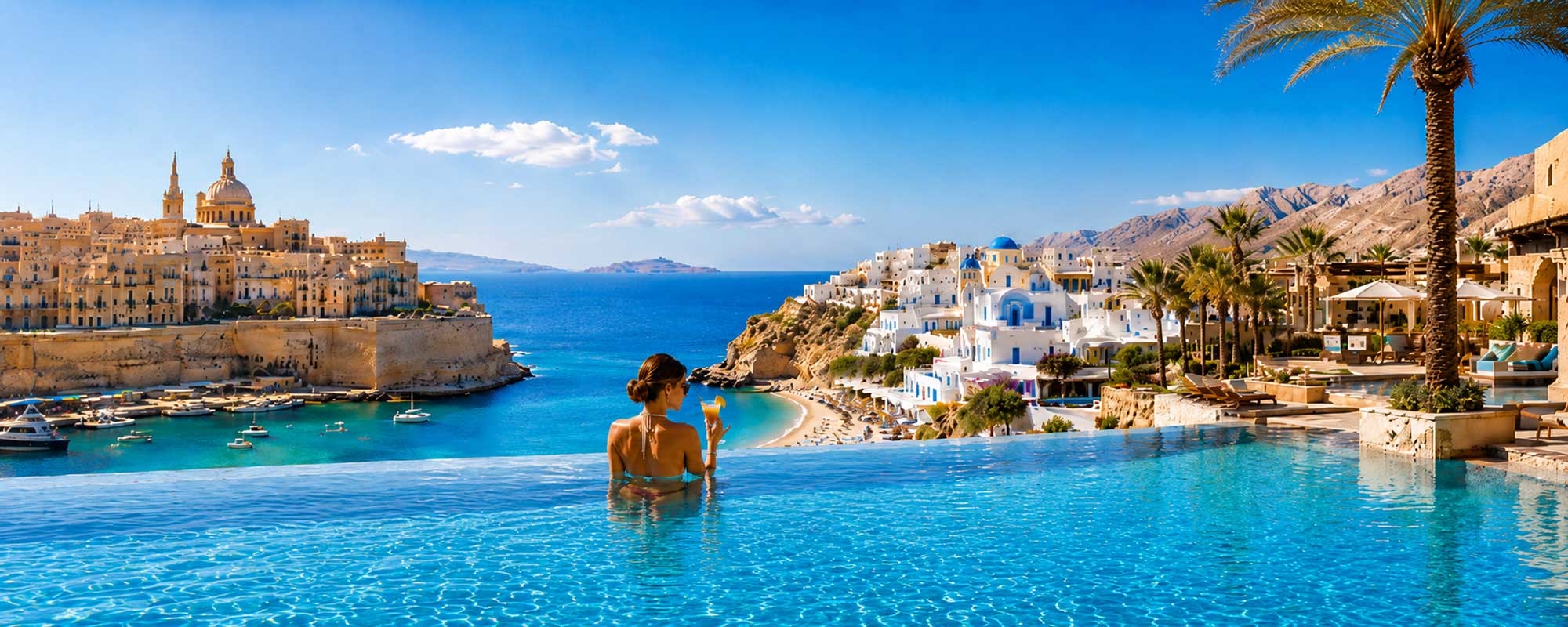
All-Inclusive Malta Holidays: Are They Worth It?
Not worse than Turkish all-inclusive. Different — and the difference decides whether you should book it.
By Thomas Kaplan · Product Manager · Last updated: August 2026
Malta does all-inclusive differently. If you are expecting Antalya-style ultra all-inclusive — endless resort facilities, 24-hour snacks, imported spirits, aquaparks and a private sandy beach with full service — Malta will surprise you, and not always in the way you expect. But if you want a convenient base, predictable meal costs and the freedom to explore one of the Mediterranean's most interesting islands, it can make perfect sense. The honest question is not whether Malta all-inclusive is worth it. It is whether all-inclusive is the right meal plan for the Malta holiday you actually want.
- Yes, it exists, and for the right traveller it offers good value and convenience.
- It is not Turkish all-inclusive. Smaller properties, narrower food and drink, lighter entertainment, often town locations.
- It works best as a meal safety net for a Malta-led holiday, not as a stay-at-the-resort experience.
- Half board is frequently the better booking here — the opposite of my advice for Turkey.
- Ask three questions before you commit. They are below, and they tell you almost everything.
What all-inclusive actually includes in Malta
There is no industry standard for the phrase, and Malta is no exception. Inclusions vary from hotel to hotel, and the marketing language on aggregator sites does not always match what guests find on arrival. The following is what is typical for this market.
| Element | Usually included | Usually extra |
|---|---|---|
| Meals | Breakfast, lunch and dinner, mostly buffet-led with one or two rotating evening themes | Multiple speciality à la carte restaurants; tasting menus; lobster nights |
| Drinks | House wine, local beer, local soft drinks and basic spirits during meal times and at the pool bar | Premium imported spirits, branded cocktails, vintage wines, espresso-bar drinks |
| Snacks | An afternoon snack or ice cream slot, usually within a defined window | 24-hour snack bars, midnight buffets, minibar restocking |
| Pool and loungers | Sunbeds, parasols and pool access during opening hours | Beach service in the Turkish sense — many Malta hotels do not front a sandy beach |
| Entertainment | Light evening entertainment in high season, occasional live music, quiz nights | Large animation teams, nightly production shows, mini-discos |
The most reliable rule: read the hotel's own all-inclusive description before you assume what is in it. The inclusions confirmed in your booking documents and the hotel's own meal-plan terms are the ones you can actually expect.
Three questions to ask before booking
If you take one practical thing from this article, take this. Before committing to an all-inclusive Malta hotel, ask the property — or our reservations team — three simple questions.
- Which drinks are included? House wine, local beer and basic spirits, or also imported brands and cocktails? Inside meal times only, or also at the pool bar during the day?
- Are snacks included outside meal times? Is there an afternoon snack window, an ice cream slot or an evening light bite — or are meals strictly breakfast, lunch and dinner?
- Are any à la carte restaurants included or discounted? Some Maltese hotels offer one rotating speciality evening or a discount voucher; others are entirely buffet. This is usually the biggest expectation gap between Malta and Turkish all-inclusive.
Those three answers tell you almost everything about whether the plan will feel generous or basic on the day.
How Malta compares with Turkey and Egypt
Many of the questions we get about Malta all-inclusive come from guests who have previously holidayed in Antalya, Bodrum, Hurghada or Sharm El Sheikh. That is a reasonable reference point, and it is also the main source of mismatch.
| Expectation | Turkey / Egypt style | Malta reality |
|---|---|---|
| Resort size | Large beachfront resorts, often 800–2,000 rooms | Smaller hotels, often in town or coastal-town locations |
| Food | Large buffets plus several speciality à la carte restaurants | Mostly buffet-led, with one rotating themed evening typical |
| Drinks | Wider selection, often including imported brands | Usually local; premium spirits typically charged |
| Beach | Long sandy beach with sunbed and towel service | Rocky coastline, hotel lidos, town beaches or short bays |
| Entertainment | Large animation programmes, nightly shows, mini-discos | Lighter, and varies by hotel and season |
| Aquaparks | Common in the major resorts | Rare — the island's scale does not support them on site |
| How you use it | Resort-based; the hotel is the destination | Malta rewards getting out; the island is the destination |
None of this makes Malta worse. It makes it different, and the trade is different too: Malta is a destination you actively explore, where Turkish and Egyptian ultra all-inclusive resorts are often built so that you do not have to. My colleague Raşit's guide to all-inclusive Turkey holidays sets out the other side of that comparison.
Why Malta works this way
There are clear structural reasons, and understanding them is half the battle when setting expectations.
Malta is small. Around 122 square miles in total, so the hotel landscape is naturally different from the long resort coastlines of Turkey or Egypt. There is simply no room for 2,000-room beachfront mega-resorts. The largest Maltese resorts are a fraction of the size of their Turkish equivalents, and that affects everything from the number of on-site restaurants to the volume of drinks a property can sustainably include in the rate.
Malta is an EU cost base. Labour, food, utilities and tax structures sit at European levels rather than Turkish or Egyptian ones. The same staffed buffet costs significantly more per cover in Mellieħa than in Antalya, and that flows through into either narrower inclusions or higher headline prices.
Most food and drink is imported. Malta has a limited agricultural base and a small domestic spirits industry. What is offered inclusively is usually local — Marsovin and Delicata for wine, Cisk for beer, Maltese producers for basic spirits. Premium imports carry duty, freight and EU pricing, and are almost always supplements.
The tourism mix is broader. Malta receives city-break visitors, history and culture travellers, divers and language students alongside beach holidaymakers. Pure beach-resort all-inclusive has never been the dominant model the way it has in Antalya, Sharm or Hurghada.
The hotel typology is different. Many Maltese hotels are urban or town-edge properties that grew alongside Sliema, St Julian's, Bugibba, Qawra and Mellieħa. They were built for guests who would walk five minutes to the promenade, the cafés, the boat trips and the bus stops. That is a different design brief from an isolated resort whose promise is that you never need to leave.
The right way to use all-inclusive in Malta
Here is the framing that turns Malta all-inclusive from a possible disappointment into a genuinely smart choice.
Malta rewards getting out. The unique value of this holiday sits outside the hotel: Valletta, Mdina and Rabat, the Three Cities, the Sunday market at Marsaxlokk, Comino and the Blue Lagoon, Gozo and the Cittadella, Ramla Bay, and the village fiestas through the summer. A week spent only at the hotel pool misses what makes Malta Malta.
So the job of all-inclusive here is not to lock you in. It is to remove meal-cost uncertainty so you can spend the day exploring without worrying about the bill.
The travellers who get most from it plan the week with that in mind. Breakfast at the hotel. Days out exploring or swimming. Lunch sometimes on the road, sometimes at the pool bar if the plan covers it. Dinner back at the hotel with a glass of local wine. A drink on the terrace before bed. That is a different rhythm from sitting by the same pool from nine until nine, and Malta rewards it.
If that is not your idea of a holiday — if you want to be on a sunbed by the sea, in front of the same buffet, with the same view, all week — Malta is probably the wrong destination for you regardless of meal plan. That is not a criticism of the island or of you. It is a mismatch, and it is better identified now than on day three.
Half board versus all-inclusive
Half board deserves serious consideration in Malta, and we routinely recommend it for guests who plan to be out most days. It typically covers breakfast and dinner at the hotel, with lunch taken out — which on this island is genuinely affordable. A pastizz from a local bakery still costs around a euro, a casual seafront lunch in Sliema or Mellieħa generally sits in the region of fifteen to twenty-five euros a head, and a sit-down lunch in Valletta or Mdina is a modest treat rather than a budget event.
- You have young children who eat regularly at the hotel
- You prefer evening drinks at the hotel bar and want them included
- You want zero on-trip cost decisions
- The hotel genuinely includes a strong pool-bar or snack offer
- You are travelling in a large group with mixed budgets
- You are a couple planning three or more lunches out
- You want to taste Maltese food beyond the buffet
- You would resent "wasting" an included meal to eat out
- Your week includes several excursions or a Gozo overnight
- You are staying in Sliema or Valletta, where eating out is the point
The rule of thumb: if you would eat lunch outside the hotel on four or more days of a seven-night trip, sit down with the price difference and run the numbers. Often half board comes out ahead, and you get a better holiday as well as a cheaper one.
Where the all-inclusive properties are
Concentrated in two areas, and there is not really a third. In St Paul's Bay and Qawra: db San Antonio Hotel & Spa, db Seabank Resort & Spa and Qawra Palace Resort & Spa. Towards Mellieħa and Marfa: Ramla Bay Resort and the adults-only Riviera Spa Resort.
If your area choice is not yet settled, my guide to where to stay in Malta works through it by holiday type.
Frequently asked questions
Is all-inclusive worth it in Malta?
For the right traveller, yes — particularly families with young children, guests who want evening drinks included, and anyone who wants no on-trip cost decisions. But it is a narrower product than the Turkish equivalent, and if you plan to eat out several times, half board usually works out better both financially and as a holiday.
Why is Malta all-inclusive different from Turkey?
Four structural reasons: the island is small, so there is no room for 2,000-room resorts; it is an EU cost base, so labour and food cost European rather than Turkish money; most food and drink is imported; and Malta's tourism mix has always been broader than pure beach holidays. The result is smaller properties with narrower inclusions rather than lower standards.
What drinks are included in Malta all-inclusive?
Typically house wine, local beer, local soft drinks and basic spirits, usually during meal times and at the pool bar. Premium imported spirits, branded cocktails and vintage wines are almost always charged as supplements, because import duty and freight make them genuinely expensive on the island. Always confirm the specific hotel's terms.
Is half board better than all-inclusive in Malta?
Frequently, yes — which is the opposite of my advice for Turkey. Lunch out is affordable here, Malta's restaurant scene is one of the reasons to visit, and the island rewards being out rather than at the pool. If you would eat lunch outside the hotel on four or more days of a week, compare the price difference carefully before defaulting to all-inclusive.
Which Malta hotels are all-inclusive?
They are concentrated in St Paul's Bay, Qawra and Mellieħa — db San Antonio, db Seabank, Qawra Palace, Ramla Bay Resort and the adults-only Riviera Spa Resort among them. There is very little genuine all-inclusive elsewhere on the island, so choosing that board basis effectively also chooses your area.
Do Malta all-inclusive hotels have aquaparks?
Generally not. The island's scale does not support resort-grade aquaparks on site the way the Turkish and Egyptian coastlines do. Maltese hotels offer pools, and sometimes lido platforms for sea access, but families expecting a Turkish-style slide complex should adjust expectations or choose a different destination.
How much is lunch out in Malta?
At the time of writing, a pastizz from a local bakery costs around a euro, a casual seafront lunch generally falls somewhere between fifteen and twenty-five euros a head, and a proper sit-down lunch in Valletta or Mdina is a modest treat rather than a significant expense. Prices change, so treat these as indicative when comparing board bases.
Official guidance and sources
All-inclusive inclusions vary considerably by property and by rate, and are not standardised. Confirm the specific hotel's meal-plan terms in your booking documents rather than relying on general descriptions.
- UK Government — Malta entry requirements
- Which? — Package holiday consumer guidance
- Thomas Kaplan · product inspection visits across Maltese all-inclusive properties
- Caria Holidays Ltd · ATOL 11211 · Package Travel Regulations registered
Related reading from our specialists
- The complete Malta country guide
- Malta's four resort areas compared
- What all-inclusive means across our destinations
- Browse every hand-picked Malta hotel
Let me run the numbers with you
Tell me how many lunches you expect to eat out and I will price all-inclusive against half board for your dates. Often the answer surprises people.